×
What's new

Vocal mics

ElectraHeart

New member
What are your favourite vocal mics (could be yours, mics you've used at studios, anything)? Maybe also give us a bit about why you like them and the kind of voices that they really suit :)
 
Really depends on how much you're willing to spend.

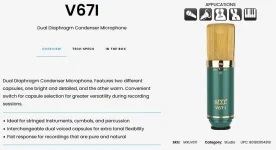
When I was first starting to record vocals on my own, I didn't have the budget to buy an expensive Neumann or other top-line mic. So a friend, who's a veteran engineer and owner of a large commercial recording studio, recommended I get the MXL V67i.

He actually has 7 of them in his arsenal (along with many other hi-end mic's) and uses them daily on just about everything, from vocals to guitars to keyboards. Over the years, this mic has worked really well for me, so much so, that I never bothered to upgrade to something more expensive.

I used the MXL to record a jazz singer who initially recorded some of her vocals in a big studio with a Neumann, but then finished the remainder of her vocals in my home studio. The MXL was just a tad brighter than the Neumann (easily remedied with minimal EQ) but otherwise matched the Neumann in tone and color. In the final mix, you can't tell the difference between vocals she recorded with this mic and the Neumann, even on tracks that were comped from a combination of both.

The V67i costs around $150 and delivers huge bang for the buck! And if you feel like spending more, MXL offers a more pricey tube version of this mic.

1739311842217.webp

Note: I am in no way affiliated with MXL - just a happy customer.
 
My first real studio mic was the original Audio Technica AT-4033. I bought it back in the early '90s, used it extensively on vocals, and still have it today.

But my go-to workhorse vocal mic for the past 20+ years has been an original Studio Projects C-1, which I modded with an EQ circuit. My comfort level with that mic simply grew over time, so it became kind of a benchmark mic for me.

One of my favorite alternative vocal mics is my MXL-R77L ribbon. I recently recorded an album of adult contemporary ballads from the '50s and '60, and used it of a few of the lead vocals for variety. But where I liked using it most was on a pop single I recorded a few years ago. I used my Studio Projects C-1 for the lead and harmony vocals, but recorded the stacks using the R77L. The vocalist was so impressed that a couple weeks later, she posted on social media a picture of her holding her new R77 mic.
 
For studio recordings I love my Neuman TLM 102 which fits my voice nicely and gives it air / presence in the mix. Imo it sounds clear and natural and also works well for recording acoustic guitar.

As a dynamic mic I very much enjoy to use my Sennheiser E845 S which I extensively tested against the Shure SM57 and SM58. I always wanted to have a SM57 but it was very obvious that the Sennheiser is a way better fit for my voice.
 
We live in a wondrous age of affordable mics... and as some of you may know, I'm reasonably obsessed with them. :) I'm not, mind you, a particularly good singer (beyond the occasional BGVs) but I've recorded some song demos in the past and managed to wrangle some good results out of things. I've also arranged/produced a number of recording sessions involving vocalists at some very good studios. So that's my context, take it for what it's worth.

I'm an unapologetic Neumann fan, and my favorite vocal (and instrument) mics tend to be the plenty-expensive U87 and even-more-expensive U67... Along with my favorite mic of all, the mighty M49. But these luxury items are not necessary for good recordings, we have great affordable options at the moment (for now).

Aside from my U87, my favorite vocal mic is my much less expensive 3U Audio Warbler MKID. It's modeled after the original run of the U87 (pre-Ai) and it really does a great job. Tames high end nicely while letting enough detail through. 3U is the work of Guosheng Zhuang, a Chinese-Australian engineer who mainly makes capsules for other manufacturers, but his own mics are really quite excellent and I'd recommend them over the companies he supplies. He only sells through his website and eBay so you won't see these on Sweetwater or Thomann, but I'd recommend checking them out if you want a better-quality studio mic in the $300-400 range.

There are some other solid lower-cost studio mics out there by Roswell, Vanguard, Miktek, Lauten, and the venerable Audio-Technica (I still have and love my AT4033 as well). Regardless of what you get, taking the time to learn to get the most out of your gear and your room (and your voice) will matter most!
 
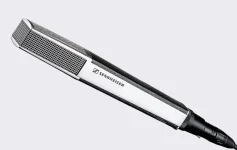
I use the Sennheiser 441-U for speech, singing, and just about anything else (have two of them).

Pros

-Versatile work horse dynamic, with five position rotary rolloff switch and treble control slider.

-What makes it special: The sound quality is superior compared to typical dynamic mics, but without the high sensitivity of a condenser. You might say it is “flattering” or forgiving for close miking. The mic has its own tone and subtle character (not a “transparent” mic). This tone is not at all overbearing, but pleasing ("clear and warm"--not “dark") with a smooth frequency response.

-The supercardioid pattern and lower sensitivity are well suited for home studios without the nicest room tone and higher background noises.

-Takes EQ and compression well.

-Quality product made in Germany.

-Looks :cool:
Screenshot 2025-02-13 at 8.30.21 AM.webp

Cons

-Pricey for a dynamic mic (around $1000).

-Long and relatively heavy, so needs a sturdy stand.

-Needs plenty of quiet gain for recording the human voice and quieter acoustic instruments. So performs best paired with a high gain and low noise mic pre.

-Consistency/variability: This might not be a con unless recording with a stereo pair. The two that I own sound and measure (frequency response graph is furnished with each individual mic) different from one another. Not a drastic difference, but enough where I pay attention to which one I’m grabbing, depending on the voice or instrument. For instance, one of them has a slightly more pronounced upper mid bump. Personally, I like it this way as each mic is almost like a unique musical instrument.
 
Last edited:
Regardless of what you get, taking the time to learn to get the most out of your gear and your room (and your voice) will matter most!
This is SO, SO, SO important, it could never stressed enough!

A couple years ago, I wrote an article that I was intending to submit to SoundBetter. It was a guide for remote singers that talked about getting good tracks. I never finished it, but now that we have this forum, I think it would be beneficial to finish it and post it here, so I'll get working on that.
 
I started out with an AT 2025 or 2035. I can't remember which it was without pulling it out. It worked well. I got it at guitar center because I could test it out with my voice. Eventually, I got a Slate ML-1. It was about $1k when I got it. Came with all these mic modeling options. It had a very flat response to work with the modeling software. I ended never using the modeling software, but I loved the mic on its own. I also have a few XML's I picked up on sale just for something different. One is a ribbon. Not sure it sounds that much different.

My biggest problem is dealing with the dynamics. I can sing in a whispery quiet tone to a full on belt in the same song. Trying to get it to sound like the same take without changing settings too much can be a challenge.
 
My biggest problem is dealing with the dynamics. I can sing in a whispery quiet tone to a full on belt in the same song. Trying to get it to sound like the same take without changing settings too much can be a challenge.
Yes, I can very much relate to the problem with the dynamics. 😊 Besides changing the distance to the mic while singing, if possible, I try to separate tracks for louder / quiter parts so I can record at different levels and easier add different processing to the separate tracks later.

Of course, if the dynamics occur in one take it can get tricky. 😅 Sometimes volume automation before the compressor can help a lot. This way you can balance the signal out by hand and the compressor doesn‘t have to work too hard (and maybe change the sound for worse by doing so).
 
Yes, I can very much relate to the problem with the dynamics. 😊 Besides changing the distance to the mic while singing, if possible, I try to separate tracks for louder / quiter parts so I can record at different levels and easier add different processing to the separate tracks later.

Of course, if the dynamics occur in one take it can get tricky. 😅 Sometimes volume automation before the compressor can help a lot. This way you can balance the signal out by hand and the compressor doesn‘t have to work too hard (and maybe change the sound for worse by doing so).
I have the foot forward/foot back position when singing so I lean forward for quiet and back for loud. I stay in pretty much the same positions for each so the sound is close to the same.

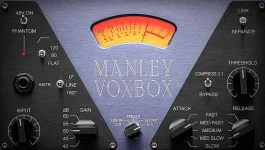
Years ago I had a great setup with outboard gear and a mixer. Then I got a Babyface Pro with only basically 2 in/2out. The in is for the mics. The out is for the speakers. Everything is in the box. But then I got a Manly VoxBox. How to set up outboard gear? I guess I could double mic with one straight in and one through the Manly? Maybe I will start a new thread once I am ready to figure it all out.
 
I used to (half)joke that I could do an entire session with a stereo pair of AKG414s (except for drums, probably)
The studio where I was staff engineer also had a nice selection of Neumann(s) U 87s mainly (but do I remember a couple of U67s, as well?)

For playing live, I used a 58 for decades, but when I was looking to upgrade, I auditioned a Beta 58 and a Sennheiser 421. . .
Then I stumbled upon Audix OM-series--and I have never looked back
 
I have the foot forward/foot back position when singing so I lean forward for quiet and back for loud. I stay in pretty much the same positions for each so the sound is close to the same.

Years ago I had a great setup with outboard gear and a mixer. Then I got a Babyface Pro with only basically 2 in/2out. The in is for the mics. The out is for the speakers. Everything is in the box. But then I got a Manly VoxBox. How to set up outboard gear? I guess I could double mic with one straight in and one through the Manly? Maybe I will start a new thread once I am ready to figure it all out.
You should be able to route your Manley through the 1/4" line-in inputs on the side of your Babyface. I have a stereo Phoenix Ascent preamp that I've routed through those lines on my own Babyface Pro FS to leave the two clean preamps on the Babyface available (even though I haven't used them since getting the Phoenix, which is a fantastic amp too).

I think you can also use the XLR inputs on the Babyface as line inputs, bypassing the preamps (I'm guessing through a control in TotalMix), but I haven't tried it myself.
 
You should be able to route your Manley through the 1/4" line-in inputs on the side of your Babyface. I have a stereo Phoenix Ascent preamp that I've routed through those lines on my own Babyface Pro FS to leave the two clean preamps on the Babyface available (even though I haven't used them since getting the Phoenix, which is a fantastic amp too).

I think you can also use the XLR inputs on the Babyface as line inputs, bypassing the preamps (I'm guessing through a control in TotalMix), but I haven't tried it myself.
I'll give it a try. I've been trying to set up my studio between everything else. Plus building a new studio computer as my desktop was acting up. I build a studio computer and move the old studio to desktop duty. And now I can't find my box of screws and computer parts. It's not where I saw it last. Who knows where I put it down for a second. (excuse my language but effing ADHD is driving me batshit crazy lately)

I was actually trying to remember how to set it up as a send, but the last time I used sends was with the Digi001, so it has been a while.
 
Manley is great gear, that'll be a high-end tracking chain you can keep forever, or sell and get most of your money back.

I definitely wouldn't set it up as a send/return, that's a top-tier tracking chain you have there and it should be your entire front-end! No reason to use the preamps on your RME, you'd be skipping most of the reason to use the Manley. Let it be your mic amp (as well as EQ and comp) and just run that line into your Babyface. A good voice with a good mic in a good room going through that box should get results on par with any great studio in the world.
 
I definitely wouldn't set it up as a send/return, that's a top-tier tracking chain you have there and it should be your entire front-end! No reason to use the preamps on your RME, you'd be skipping most of the reason to use the Manley. Let it be your mic amp (as well as EQ and comp) and just run that line into your Babyface. A good voice with a good mic in a good room going through that box should get results on par with any great studio in the world.
That will make it easier. I will try setting it up that way.
 
I have saved myself a boatload of money the last couple of years deciding not to spend money on more microphones when I realized how horrible my voice has become after years of smoking and various forms of neglect towards my vocal cords. No microphone is going to fix that 😱
My voice is shot.
 
Last edited:
Back
Top Bottom